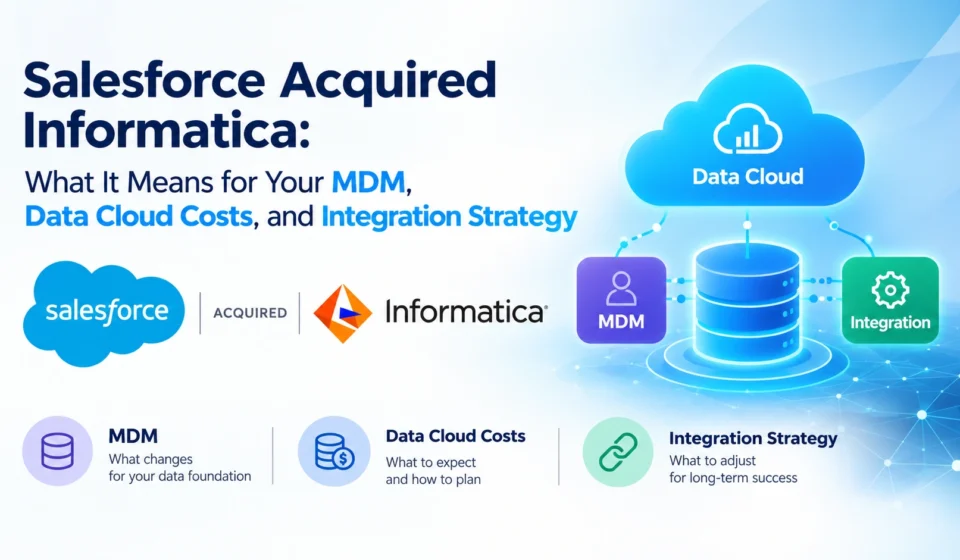
Salesforce Acquired Informatica: What It Means for Your MDM, Data Cloud Costs, and Integration Strategy

Table of Contents
Salesforce’s acquisition of Informatica has moved from announcement to reality. Salesforce completed the acquisition on November 18, 2025, bringing Informatica’s data integration, data quality, governance, metadata management, privacy, and Master Data Management (MDM) capabilities into the Salesforce portfolio.
For enterprises using Salesforce, Informatica, MuleSoft, Data Cloud/Data 360, or a combination of these platforms, the acquisition raises an important question:
What actually changes for your data architecture, MDM strategy, integration roadmap, and technology costs?
The short answer is: probably not everything at once.
Salesforce is integrating Informatica capabilities into its broader data and AI platform, but existing Informatica customers are not being told to immediately replace their current architecture. Salesforce says Informatica will continue supporting its existing data management solutions and partner integrations while its technology is progressively integrated with Salesforce.
That makes this less of a “rip and replace” event and more of a reason to reassess your data strategy.
What Did Salesforce Actually Buy?
Salesforce agreed to acquire Informatica in May 2025 for approximately $8 billion in equity value, net of Salesforce’s existing investment in Informatica. The transaction subsequently closed in November 2025.
The significance of the deal isn’t simply that Salesforce acquired another software company.
Informatica brings capabilities that sit underneath enterprise applications:
- Data integration
- Data quality
- Data governance
- Data cataloging
- Metadata management
- Data privacy
- Master Data Management
- Data lineage
- Enterprise data management
Salesforce already had important pieces of the enterprise data stack through products such as Data 360 and MuleSoft.
Informatica gives Salesforce a much broader data-management layer across systems that exist outside Salesforce.
That distinction matters.
A typical enterprise doesn’t store all its important data in Salesforce. Customer, product, supplier, finance, employee, transaction, and operational data may be distributed across ERP systems, data warehouses, SaaS applications, databases, and cloud platforms.
Informatica’s technology is designed to operate across that broader environment.
Salesforce has described the combined architecture as a foundation for what it calls trusted context for enterprise AI.
1. What Does the Acquisition Mean for MDM?
This may be the biggest immediate consideration for organizations using Informatica MDM.
Salesforce’s Data 360 and Informatica MDM solve related—but different—problems.
Salesforce itself distinguishes the two:
Informatica MDM creates and manages golden records, while Data 360’s Identity Resolution creates unified profiles by linking data from different sources. Salesforce specifically notes that Data 360 is not an MDM system and does not replace Informatica MDM functionality.
Consider a financial services organization.
It may have:
- Multiple customer records in Salesforce
- Customer records in a core banking system
- Investment-account data
- Marketing data
- Support records
- Third-party enrichment data
Data 360 can help bring these datasets together to create a unified customer view.
But MDM addresses a different question:
What is the authoritative customer record that the organization should trust?
That is where Informatica MDM becomes important.
It can establish standardized, deduplicated and governed master records—the so-called golden record.
The practical implication
If your organization already uses Informatica MDM, the acquisition doesn’t automatically mean you should replace it with Salesforce Data 360.
Instead, you should evaluate how the two capabilities should work together.
Salesforce’s current documentation explicitly describes IDMC and Data 360 as capabilities that can operate in parallel.
A possible architecture could look like:
Enterprise systems → Informatica integration & quality → MDM → Data 360 → Salesforce / Agentforce
Rather than:
Enterprise systems → Salesforce → everything
That distinction is particularly important for organizations where master data spans multiple business domains.
2. What Happens to Your Informatica Investment?
For existing Informatica customers, the first concern is usually contractual and operational:
Do I need to change my platform now?
There is currently no indication that existing customers should immediately abandon Informatica products.
Salesforce says Informatica will continue supporting existing data management solutions and partner integrations.
That means organizations should avoid making rushed architectural decisions simply because ownership has changed.
Instead, look at your current Informatica footprint.
for example
| Area | Questions to Ask |
|---|---|
| MDM | Which domains depend on Informatica MDM? |
| Integration | Which pipelines run through Informatica? |
| Data Quality | Which systems depend on Informatica rules? |
| Governance | Where is metadata and lineage managed? |
| Data Catalog | Which teams depend on catalog capabilities? |
| Contracts | When do current agreements renew? |
| Architecture | Which systems are dependent on Informatica APIs? |
| Roadmap | Are you planning Data 360 or Agentforce? |
This gives your organization a much better basis for deciding what to do next.
3. What Does This Mean for Salesforce Data Cloud?
Salesforce Data Cloud has evolved into Data 360, and Informatica’s capabilities are being integrated into Salesforce’s broader data platform strategy.
This could materially change how organizations approach customer data.
Previously, you might have had separate technologies for:
Data integration → data quality → MDM → customer data platform → CRM → AI
The Salesforce strategy is moving toward bringing more of these capabilities into a connected ecosystem.
Salesforce says Informatica’s data quality, governance, metadata and integration capabilities will strengthen Data 360 and the wider Agentforce platform.
This doesn’t necessarily mean every company needs every Salesforce data product.
In fact, this is where organizations should be careful.
4. Will Your Data Cloud Bill Increase?
This is one of the most practical questions—and one that cannot be answered simply by saying “yes” or “no.”
The acquisition itself does not automatically mean your Salesforce bill will increase.
Your actual cost depends on what products you purchase, how much data you process, the architecture you implement, usage levels, existing contracts, and the commercial terms offered to your organization.
But the acquisition can change the number of capabilities you may consider buying from Salesforce.
For example, an organization could potentially have requirements involving:
- Data 360
- Informatica MDM
- Informatica Data Quality
- Informatica Data Integration
- MuleSoft
- Agentforce
- Tableau
- Salesforce CRM
The more capabilities that become strategically connected, the more important it becomes to evaluate the total technology footprint rather than pricing each product independently.
Don’t evaluate Data Cloud in isolation
Before expanding Data 360 usage, calculate:
Current data-management cost
Data 360/Data Cloud costs
Integration costs
MDM costs
Data engineering costs
Data governance costs
AI-related data costs
This provides a more realistic view of your total cost of ownership.
5. What Does It Mean for MuleSoft?
MuleSoft is another important part of the story.
Salesforce has said the combination of MuleSoft’s application integration and API capabilities with Informatica’s data integration and governance capabilities can provide a broader integration offering.
But MuleSoft and Informatica shouldn’t simply be treated as interchangeable products.
Their historical strengths are different.
MuleSoft is heavily associated with:
- APIs
- Application integration
- API management
- System connectivity
- Reusable integration assets
Informatica has extensive capabilities across:
- Data integration
- Data quality
- Data governance
- Metadata
- MDM
- Data management
That means the future architecture may involve both.
For example:
ERP → Informatica → governed/mastered data → Data 360
while
Salesforce ↔ MuleSoft ↔ enterprise applications
handles application-level connectivity and APIs.
The exact division will depend on the organization’s architecture and Salesforce’s evolving product strategy.
6. Should You Replace Informatica With MuleSoft?
Not automatically.
This is one of the mistakes organizations could make after the acquisition.
The fact that Salesforce owns both technologies doesn’t mean they have identical purposes.
Before replacing an Informatica implementation, document:
- What data is being moved?
- Why is it being moved?
- What transformations are applied?
- Where are quality rules implemented?
- Where is master data maintained?
- Where is lineage captured?
- Which downstream systems consume the data?
- What APIs depend on the current architecture?
- What regulatory controls exist?
- What would migration actually cost?
The technical migration may be much more expensive than the software license itself.
7. What About Organizations Using Snowflake, Databricks or Microsoft Fabric?
This is another area where the acquisition shouldn’t be interpreted as “everything must move into Salesforce.”
Informatica’s data-management capabilities continue to operate across broader enterprise environments.
Salesforce currently positions Informatica across environments including AWS, Microsoft, Databricks and Snowflake.
Informatica has also highlighted MDM integration with Databricks and governance capabilities spanning platforms such as Microsoft Fabric, Databricks and Snowflake.
So organizations with an existing lakehouse or data warehouse strategy don’t necessarily need to abandon it.
Instead, the architecture can potentially look like:
Operational systems
↓
Informatica integration / quality / governance
↓
MDM and trusted data
↓
Data warehouse / lakehouse
↓
Data 360
↓
Salesforce / Tableau / Agentforce
This makes the acquisition relevant even to companies that aren’t planning to consolidate their entire technology stack around Salesforce.
8. What Does This Mean for Agentforce and AI?
This may ultimately be the biggest strategic reason Salesforce wanted Informatica.
AI agents need more than access to data.
They need accurate, contextual and governed data.
Imagine an AI agent answering:
“What is this customer’s current relationship with our company?”
If customer information exists across Salesforce, an ERP, a data warehouse, support systems and third-party databases, simply connecting the systems doesn’t guarantee that the answer is correct.
The underlying data needs to be:
- Accurate
- Consistent
- Current
- Governed
- Traceable
- Contextual
That’s where MDM, data quality, metadata and lineage become important.
Salesforce’s stated strategy is to combine Informatica’s data-management capabilities with Data 360, MuleSoft and Agentforce to create a broader trusted-data foundation for AI.
9. What Should Enterprise IT Teams Do Now?
The acquisition doesn’t require an immediate technology overhaul.
A better approach is to conduct a structured assessment.
Step 1: Inventory your current platforms
Document your usage of:
- Salesforce
- Informatica
- MuleSoft
- Data 360
- Data warehouses
- Lakehouses
- MDM
- ETL/ELT platforms
- Data governance tools
Step 2: Map your data flows
Identify:
Source → transformation → governance → MDM → destination
This often reveals overlapping capabilities.
Step 3: Review contracts
Pay particular attention to:
- Renewal dates
- Usage commitments
- Data volumes
- Product bundles
- Expansion clauses
- Support arrangements
Step 4: Separate MDM from customer unification
Don’t assume a unified customer profile and a master record are the same thing.
They serve different purposes.
Step 5: Model three-year TCO
Compare your current architecture against potential future architectures.
Include:
- Licensing
- Implementation
- Migration
- Integration
- Data engineering
- Governance
- Operations
- Training
- Support
Step 6: Align the architecture with AI plans
If Agentforce or other enterprise AI initiatives are on your roadmap, examine whether your existing data foundation is ready for them.
The Bottom Line
Salesforce’s acquisition of Informatica is bigger than a conventional software acquisition because it connects three areas that are becoming increasingly dependent on one another:
Enterprise data → trusted context → AI
For Informatica customers, the immediate takeaway isn’t that existing systems need to be replaced.
For Salesforce customers, it isn’t that Data 360 automatically becomes the answer to every data-management problem.
And for organizations evaluating their next data platform, it isn’t simply about choosing between Salesforce and Informatica.
The more useful question is:
How should MDM, data quality, integration, governance, Data 360 and AI work together across our existing enterprise architecture?
That question becomes particularly important as Salesforce continues integrating Informatica’s capabilities into its broader platform.
For now, organizations should focus on understanding their current architecture, separating MDM requirements from customer-profile requirements, reviewing licensing and contracts, and modeling the total cost of any future Salesforce data-platform expansion.
The acquisition creates the possibility of a much more tightly connected Salesforce data ecosystem. How valuable that becomes for an individual company will depend less on the acquisition itself and more on how intelligently that company designs its data architecture around it.
1. Did Salesforce acquire Informatica?
Yes. Salesforce completed its acquisition of Informatica on November 18, 2025. The acquisition brought Informatica’s data integration, data quality, governance, metadata management, privacy, and Master Data Management capabilities into Salesforce’s broader data and AI strategy.
2. What does the Salesforce acquisition mean for Informatica MDM customers?
Existing Informatica MDM customers do not necessarily need to replace their MDM platform immediately. Informatica MDM and Salesforce Data 360 serve different purposes, and organizations should evaluate how the technologies can work together based on their existing architecture and business requirements.
3. Will Informatica MDM be replaced by Salesforce Data 360?
Not necessarily. Data 360 can unify and connect customer data, while Informatica MDM is designed to manage authoritative master records. Organizations should assess their specific MDM and customer-data requirements before considering a replacement.
4. Will Salesforce’s acquisition of Informatica increase Data Cloud costs?
The acquisition itself does not automatically increase a customer’s Salesforce bill. Actual costs depend on the Salesforce products being used, data volumes, usage, contracts, implementation requirements, and commercial terms.
5. Should companies using Informatica migrate to MuleSoft?
Not automatically. MuleSoft and Informatica have different areas of strength. MuleSoft is widely used for APIs and application integration, while Informatica provides capabilities across data integration, data quality, governance, metadata, and MDM. A migration should be evaluated based on the organization’s architecture and requirements.
6. Can Informatica work with Snowflake, Databricks, and Microsoft Fabric?
Yes. Informatica’s data-management capabilities are designed to work across heterogeneous enterprise data environments, including cloud data platforms and lakehouse technologies. Organizations do not necessarily need to move their entire data platform to Salesforce following the acquisition.
7. What does the acquisition mean for Agentforce?
The acquisition gives Salesforce additional data integration, quality, governance, metadata, and MDM capabilities that can contribute to the trusted data foundation required by AI agents. The practical impact will depend on how an organization manages and connects its enterprise data.
8. Should companies change their data architecture because of the acquisition?
Not immediately. Organizations should first inventory their current Salesforce, Informatica, MuleSoft, MDM, data warehouse, lakehouse, and governance environments. They can then evaluate future architecture, licensing, migration costs, and AI requirements before making major changes.